

5 Essential HACCP Compliance Checklist Items for 2026
Table of Contents
- 1. Hazard Analysis and Critical Control Points Identification
- 2. Establishing and Documenting Critical Limits
- 3. Monitoring Procedures and Real-Time Compliance Tracking
- 4. HACCP Record-Keeping Best Practices and Documentation Standards
- 5. Corrective Actions and Verification Procedures
- 6. Food Safety Equipment Maintenance Logs and CFIA Food Safety Preventive Control Plan Integration
- Conclusion
- Frequently Asked Questions
Last Updated: September 18, 2026
1. Hazard Analysis and Critical Control Points Identification
Hazard analysis is the systematic process of identifying potential biological, chemical, or physical hazards that could contaminate food during processing, storage, or preparation. This foundational step determines which control points matter most for your operation.
The first thing most food businesses get wrong is treating hazard analysis as a checkbox exercise. It's not. A proper analysis examines your specific workflow, ingredient sources, equipment condition, and staff practices. You're looking for where contamination could realistically happen, not where it theoretically might.
Start by mapping your entire food production process from raw materials to final product. Document every step: receiving, storage, preparation, cooking, cooling, reheating, and packaging. At each stage, ask what could go wrong. Raw chicken arriving at your receiving dock? Biological hazard. Cleaning chemicals stored near food prep areas? Chemical hazard. Dented cans that bypass inspection? Physical hazard.
The Canadian Food Inspection Agency provides guidance on hazard identification for food safety programs. Your analysis should reference their standards and your local regulations. This isn't bureaucratic overhead, it's the difference between catching problems before they reach customers and managing a recall.
Document your findings in writing. Include the hazard, the likelihood it could occur in your operation, and the severity if it does. This written record becomes your audit trail and demonstrates due diligence to regulators. EESi Service works with food processors and restaurants across Central Alberta who understand that proper equipment maintenance directly supports hazard control, a broken cooler creates a biological hazard that no documentation can fix.
2. Establishing and Documenting Critical Limits
Critical limits are the maximum or minimum values that must be maintained at each critical control point to prevent, eliminate, or reduce hazards to acceptable levels. A critical limit isn't a suggestion, it's the boundary between safe and unsafe.
For temperature control, your critical limit might be 63°C for cooking poultry. That's not arbitrary. It's based on scientific research about pathogen destruction. Below that temperature, harmful bacteria survive. Above it, they don't. Your critical limit is that exact threshold.
The challenge is that critical limits vary by hazard, by product, and sometimes by equipment. Establishing them requires either:
- Reference to published standards (like Health Canada's food safety guidelines)
- Scientific literature or research
- Expert consultation with food safety specialists
- Validation testing specific to your process
Once you've set critical limits, document them clearly. Include the parameter being measured (temperature, pH, time), the critical limit value, and the rationale. This documentation proves you didn't guess, you applied evidence.
Many small operations set limits that are too loose because they're easier to meet. That's a liability. Set limits based on science, then ensure your monitoring and corrective action procedures can actually enforce them. If you can't reliably measure and maintain a critical limit, you need to revisit your process design.
3. Monitoring Procedures and Real-Time Compliance Tracking
Monitoring is where HACCP moves from theory to practice. It's the continuous or periodic check that your critical control points stay within critical limits.
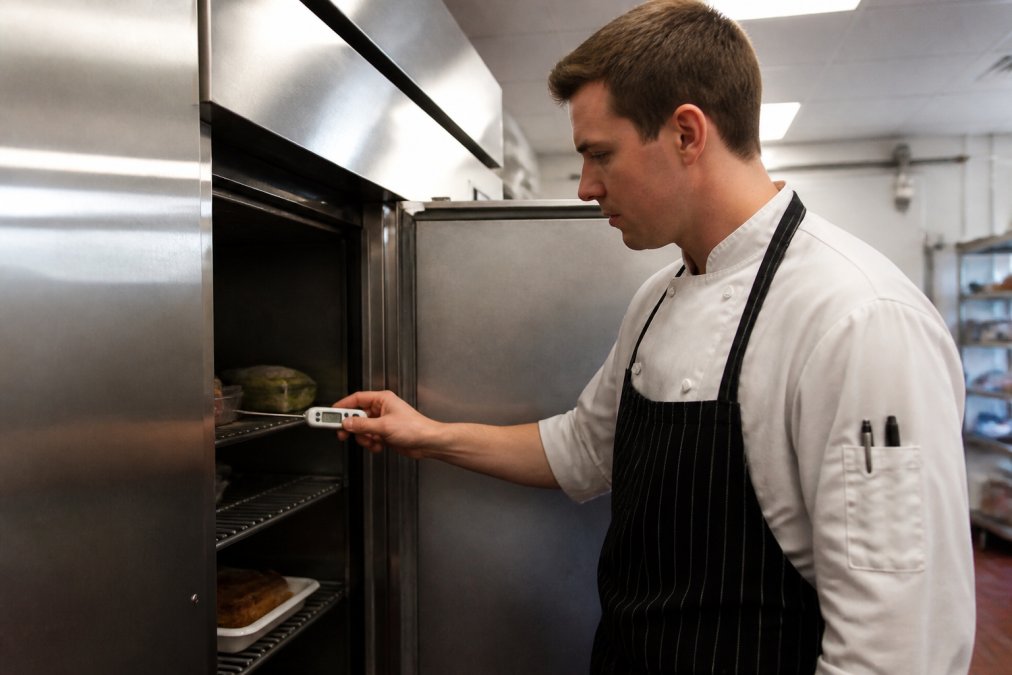
Effective monitoring requires three things: the right measurement tool, a defined frequency, and a responsible person. Temperature monitoring is the most common example. You need a calibrated thermometer, you need to check it at defined intervals (every 4 hours, every shift, daily), and you need someone accountable for recording the result.
The data matters only if it's recorded and reviewed. A thermometer reading 4°C means nothing if no one writes it down. Written records create the audit trail that proves your operation was under control. They also reveal trends, if temperatures creep upward over weeks, you catch equipment failure before it becomes a hazard.
Modern operations increasingly use digital monitoring systems that log temperatures automatically and alert staff when limits are breached. This reduces human error and creates timestamped records that are difficult to dispute. The VacMaster vacuum sealers available through EESi Service, for example, include built-in cycle monitoring that documents sealing parameters, critical for verifying that your packaging process meets food safety standards.

For monitoring procedures, document:
- What parameter is being monitored (temperature, pH, time, visual inspection)
- How it's measured (equipment, method)
- When it's measured (frequency)
- Who measures it (responsibility)
- Where results are recorded
The monitoring procedure itself becomes part of your food safety documentation. Regulators will review it to understand how you verify control.
4. HACCP Record-Keeping Best Practices and Documentation Standards
Records are the evidence that your HACCP system actually works. Without them, you have no proof of compliance.
Effective HACCP record-keeping requires consistency and clarity. Your records should document:
VacMaster VP540 Chamber Vacuum Sealer →
- Hazard analysis findings and critical limits
- Monitoring results (temperatures, times, visual checks)
- Any deviations from critical limits
- Corrective actions taken when limits were breached
- Verification that corrective actions worked
- Equipment maintenance and calibration
Keep records in a format that's easy to review and difficult to alter. Paper logs can work if they're legible and stored safely. Digital records are preferable because they're timestamped, harder to falsify, and easier to search during audits.
Retention periods vary by product and regulation. Most food safety programs require records to be kept for at least one year, though some require longer. Check the CFIA's record retention requirements for your specific product category.
The supporting keyword CFIA food safety preventive control plan integration is essential here. Your record-keeping system must align with CFIA expectations. If you're required to submit a preventive control plan, your records must demonstrate that you're executing it. Inconsistency between your documented plan and your actual records is a red flag during inspection.
5. Corrective Actions and Verification Procedures
A corrective action is what you do when monitoring shows that a critical limit has been breached. It's not optional. It's mandatory, and it must be documented.
Corrective actions have two parts: the immediate action to address the current problem, and the preventive action to stop it from happening again.
If your cooler temperature rises above 4°C, the immediate corrective action might be to move affected product to a functioning cooler and check the equipment. The preventive action is to repair the cooler, replace the thermostat, or schedule more frequent monitoring. Both must be recorded.
Your HACCP plan should define corrective actions in advance. Don't wait for a deviation to figure out what to do. Decide now: if cooking temperature drops below 63°C, what happens to that batch? Is it recooked, discarded, or diverted to a lower-risk use? Document the decision.
Verification means confirming that your corrective action actually worked. If you moved product to a backup cooler, verify the backup cooler is holding the right temperature. If you repaired equipment, verify the repair restored function. Verification closes the loop and prevents the same problem from recurring.
Common mistakes with corrective actions:
- Taking action but not documenting it
- Documenting action without verifying it worked
- Treating every deviation the same way (some require product disposal, others don't)
- Failing to identify the root cause and address it permanently
A strong corrective action system demonstrates control. A weak one suggests your operation is reactive rather than proactive.
6. Food Safety Equipment Maintenance Logs and CFIA Food Safety Preventive Control Plan Integration
Your equipment is part of your food safety system. A broken thermometer, a malfunctioning cooler, or a failed vacuum sealer can compromise your entire HACCP program.
Food safety equipment maintenance logs document the condition and performance of critical equipment.
- Equipment name and location
- Last maintenance or calibration date
- Next scheduled maintenance date
- Any repairs or adjustments made
- Results of functionality checks
Integrate equipment maintenance into your preventive control plan by:
- Listing all equipment that supports critical control points
- Defining maintenance frequency based on equipment type and manufacturer recommendations
- Assigning responsibility for maintenance tasks
- Recording all maintenance activities
- Using maintenance records to predict equipment failure before it happens
Conclusion
The five essential HACCP compliance checklist items for 2026, hazard analysis, critical limits, monitoring procedures, record-keeping, and corrective actions, form an integrated system. They're not separate tasks. Each one depends on the others.
Frequently Asked Questions
What are the 7 principles of HACCP that apply to food operations?
The CFIA recognizes seven HACCP principles: conducting a hazard analysis, identifying critical control points, establishing critical limits, implementing monitoring procedures, defining corrective actions, verifying the system works, and maintaining detailed records and documentation. These principles form the foundation of any food safety management system. Each principle builds on the previous one to create a complete food safety framework that prevents contamination, allergen cross-contact, and foodborne illness throughout your operation.
How does a CFIA food safety preventive control plan differ from a basic HACCP plan?
A CFIA food safety preventive control plan is broader than HACCP alone. It includes prerequisite programs such as sanitation standard operating procedures, allergen management, supplier verification, and staff training alongside the seven HACCP principles. The preventive control plan addresses the full food safety management system required under the Safe Food for Canadians Regulations, ensuring your operation meets all regulatory compliance requirements, not just hazard-specific controls.
How often should food safety equipment maintenance logs be reviewed for HACCP compliance?
Food safety equipment maintenance logs should be reviewed at minimum monthly, with critical equipment checked weekly or daily depending on risk level. Equipment failures directly impact your ability to maintain critical limits for temperature, time, and other controls. Regular review of maintenance logs identifies patterns of equipment degradation before they cause food safety failures, reducing downtime and ensuring your HACCP system remains effective throughout 2026 and beyond.
What records must be included in a complete HACCP manual?
A complete HACCP manual must include your hazard analysis worksheets, critical control point identification documentation, critical limits justification, monitoring procedures and frequency, corrective action protocols, verification procedures and results, and all maintenance and sanitation records. Additionally, include prerequisite program documentation, staff training records, supplier verification data, and traceability procedures. These documents demonstrate to auditors and regulators that your food safety management system is comprehensive, documented, and actively maintained.