

Alternatives to General Handyman for Mechanical Repairs
Table of Contents
- Why General Handymen Fall Short for Mechanical Repairs
- Scope of Work: When Mechanical Systems Need Specialist Attention
- How to Vet Commercial Repair Contractors
- Licensing, Insurance, and Liability: What Protects Your Operation
- Commercial Food Equipment Maintenance Services: What to Expect
- Preventative Maintenance Checklist for Meat Grinders and Band Saws
- Repair Versus Replace: Making the Right Decision
- Frequently Asked Questions
Last Updated: September 28, 2026
Why General Handymen Fall Short for Mechanical Repairs
General handymen excel at drywall and painting, but mechanical systems demand specialists. When a meat grinder motor fails or the auger seizes, you're losing revenue by the minute, and a generalist won't diagnose the problem correctly.
The core issue is specialization. Mechanical equipment in butcher shops operates under continuous high-load conditions, food-safety regulations, and thermal stress that most handymen never encounter. A technician trained on residential HVAC lacks the specific knowledge to troubleshoot a Biro grinder or diagnose why a band saw blade tracks off-center.

This is where alternatives to general handyman for mechanical repairs become essential. Specialized technicians bring hands-on experience with your exact equipment, accurate first-time diagnosis, and proper credentials, plus liability protection and warranty preservation.
Scope of Work: When Mechanical Systems Need Specialist Attention
Not every repair needs a specialist. Tightening bolts or replacing door seals can wait. But mechanical failure, motor problems, blade tracking, or grinding inconsistencies require someone who understands the equipment at a systems level.
Scope determines cost and outcome. A generalist might spend three hours troubleshooting a grinder auger that a specialist diagnoses in 20 minutes. Motor drives, belt tensioning, blade alignment, and refrigeration systems each require specific diagnostic skills.
The Handyman-Safe Repair Threshold
Handymen can safely handle:
- Fastener tightening (bolts, screws, clamps) without disassembly of drive systems
- Seal and gasket replacement on non-pressurized components (door seals, bowl gaskets)
- Cleaning and minor debris removal from non-electrical areas
- Visual inspection and reporting of equipment condition
- Basic electrical checks (confirming power is reaching the unit, checking for loose connections)
When a Specialist Is Legally or Technically Required
Specialists must handle:
- Motor diagnosis and repair, A specialist uses amperage meters to diagnose bearing wear, checks rotor balance, and understands motor load curves. A handyman risks personal injury and equipment damage.
- Refrigeration and pressure systems, Work on sealed refrigeration systems requires EPA or provincial certification. Improper handling releases refrigerant (illegal under the Ozone-Depleting Substances Regulations), voids warranties, and creates environmental liability.
- Blade and cutting-head assembly, A specialist measures blade speed with a tachometer, checks wheel runout with a dial indicator, and adjusts guides to micron tolerances. A handyman's visual assessment misses these critical parameters.
- Grinding plate and auger systems, A specialist measures plate gap with feeler gauges and verifies the grinding head is concentric to the drive shaft. Improper reassembly causes binding and motor overload.
- Drive belts and coupling systems, Belt tension must be within manufacturer specs (typically 10-15 pounds of deflection). A specialist uses a belt-tension gauge; a handyman guesses.
- Electrical component replacement, Contactors, thermal overloads, and control relays require understanding of the equipment's electrical schematic. Swapping a contactor without verifying voltage and amperage ratings can cause fire or equipment damage.
Decision Matrix: Handyman vs. Specialist
| Repair Type | Involves Moving Parts? | Affects Food Safety? | Requires Diagnosis? | Handyman Safe? | Specialist Required? |
|---|---|---|---|---|---|
| Tightening loose bolts | No | No | No | Yes | No |
| Replacing door seal | No | Possibly | No | Yes | No |
| Blade sharpening (external) | Yes | Yes | No | No | Yes |
| Motor noise or vibration | Yes | No | Yes | No | Yes |
| Refrigeration not cooling | Yes | Yes | Yes | No | Yes (certified) |
| Grinding inconsistency | Yes | Yes | Yes | No | Yes |
| Belt fraying or cracking | Yes | No | No | No | Yes |
| Electrical component failure | No | Possibly | Yes | No | Yes |
A band saw cutting unevenly: a handyman tightens bolts and calls it done. A specialist checks motor speed with a tachometer, inspects the drive belt, and verifies blade tracking under load. That thoroughness prevents the same issue recurring two weeks later.
If the repair involves moving parts, motors, sealed systems, or components affecting food safety, bring in a specialist. For equipment like the Biro 44SSFH Band Saw, only a technician trained on that specific model understands the precise tolerances required.
How to Vet Commercial Repair Contractors
Vet contractors on three criteria: credentials, experience with your specific equipment, and accountability.
Ask whether technicians hold a journeyman license or equivalent trade qualification. A business employing journeyman-certified technicians maintains accountability through licensing boards.
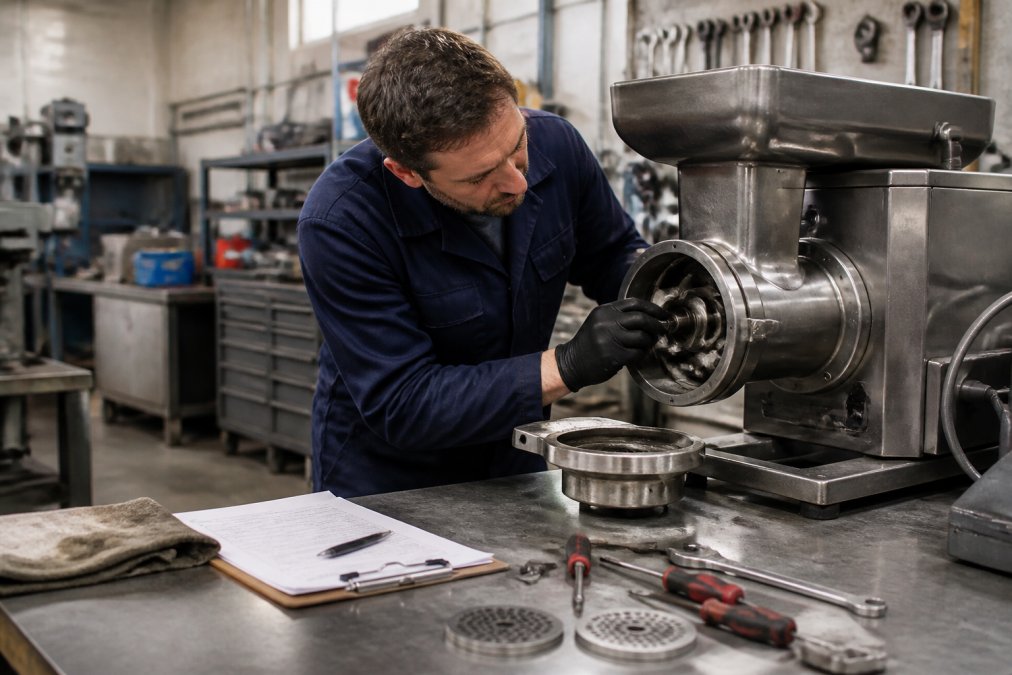
Ask about specific experience with your exact equipment model. A technician who's repaired 50 band saws knows the common failure points and can spot problems before they become catastrophic.
Request references from similar operations. Ask directly: "Did the problem come back?" If a contractor's fixes don't hold, move on.
Verify insurance and service agreements. Does the contractor carry liability insurance and offer a repair warranty? If they won't guarantee repairs or show proof of insurance, move on.
| Vetting Criterion | What to Check | Red Flag |
|---|---|---|
| Certification | Journeyman license or trade qualification | No verifiable credentials |
| Equipment Experience | Specific familiarity with your brand/model | Generic mechanical background only |
| References | Track record with similar operations | Unwilling to provide references |
| Insurance & Warranty | Liability coverage and repair guarantee | No insurance or warranty offered |
Licensing, Insurance, and Liability: What Protects Your Operation
Specialist contractors differ from handymen in licensing, insurance, warranty exposure, and regulatory compliance.
Provincial Licensing Requirements
Many provinces require specific qualifications for work on refrigeration systems, electrical components, or gas-fired equipment. A licensed technician knows these requirements; a handyman might not.
Refrigeration work is the most heavily regulated.
Manufacturer Warranty Voiding: The Hidden Cost
This is where many operators get caught. Most commercial food equipment comes with a manufacturer warranty (typically 1-3 years). That warranty is void if non-certified technicians perform repairs.
Liability Insurance: What You Need to Know
A contractor with proper liability insurance means their insurance pays for damages if a repair goes wrong. Without it, you're liable.
Regulatory Compliance and Your Exposure
Food-service equipment must meet health and safety standards. If a repair causes contamination or injury and was performed by an unqualified handyman, you're liable for negligence, a regulatory violation with potential fines or closure.
What to Verify Before Work Begins
A service agreement should specify the work, cost, timeline, repair warranty, proof of insurance, and technician certification. For refrigeration, electrical, or gas work, request proof of EPA/provincial certification or license numbers, these are legal requirements.
Commercial Food Equipment Maintenance Services: What to Expect
Preventative maintenance is cheaper than emergency repairs. A contractor should provide regular inspections, scheduled parts replacement, and early problem detection.
Preventative Maintenance Checklist for Meat Grinders and Band Saws
Use this checklist monthly or quarterly depending on your equipment volume. It helps you track maintenance and identify when specialist service is needed.
For Meat Grinders:
- Inspect grinding plates for wear or damage
- Check auger for cracks or bending
- Verify motor runs smoothly without unusual noise
- Confirm hopper lid closes securely
- Inspect bowl and paddle for cracks
- Check all bolts and fasteners for tightness
- Verify electrical connections are dry and secure
- Clean all contact surfaces thoroughly after use
For Band Saws:
- Inspect blade for cracks, dull spots, or missing teeth
- Check blade tension (should feel firm, not loose)
- Verify blade tracks straight without drift
- Inspect wheels for cracks or flat spots
- Check blade guides for wear
- Confirm motor runs without vibration
- Verify safety features function properly
- Inspect drive belt for cracks or fraying
Repair Versus Replace: Making the Right Decision
The choice between repairing and replacing depends on equipment age and reliability history.
Frequently Asked Questions
What is the difference between a general handyman and a certified mechanical technician?
A general handyman handles routine maintenance and minor repairs across multiple trades, while a certified mechanical technician specializes in complex machinery systems. Journeyman-certified technicians have completed formal apprenticeships and understand equipment-specific issues like blade alignment, motor performance, and safety standards. For commercial food equipment like meat grinders and band saws, this specialization prevents costly misdiagnosis and warranty voidance.
When should you avoid hiring a general handyman for equipment repairs?
Avoid general handymen for any repair involving mechanical systems, electrical components, or safety-critical functions. Band saw blade alignment, meat grinder auger performance, and motor issues require specialized knowledge. Misdiagnosis by a generalist can worsen the problem, void manufacturer warranties, and create liability issues. If your equipment is under warranty or involves complex mechanical systems, hire a specialist certified in commercial food equipment repair.
How do you verify the qualifications of a mechanical repair service?
Request proof of journeyman certification or trade-specific credentials. Verify liability insurance coverage and ask for references from similar operations. Check whether the service provider offers a service agreement with warranty on repairs and has experience with your specific equipment brand and model. Ask how they diagnose problems and whether they use genuine replacement parts. A reputable service will provide transparent cost estimates and explain why specific repairs are needed.
What are the risks of using a generalist for complex mechanical machinery?
Generalists lack the specialized training to diagnose mechanical failures accurately. Common risks include repeated breakdowns after repair, voided equipment warranties, safety hazards from improper adjustments, and unexpected downtime during production. For meat processing equipment, incorrect repairs can affect food safety and equipment lifespan. Specialist technicians reduce these risks by understanding equipment design, performing preventative maintenance, and using proper diagnostic tools.